
 Consumer Protection
Law Group


 Consumer Protection Law Group
Standing at a Nissan dealership in front of these two SUVs? Well, the Murano looks bigger. Smoother. Slightly more upscale. The Rogue looks modern. Efficient. Practical.
The price tags? Closer than you expected. So now you’re stuck. Do you pay a little more for size and V6 power? Or do you save at the pump and go with the compact option?
This isn’t just about space. It’s about long-term costs. Ride comfort. Reliability history. And how you actually drive. Before making your final call, it helps to know the Nissan Murano years to avoid so you don’t end up with a model that brings headaches down the road.
Some buyers assume the Murano is automatically “better” because it’s larger. Others assume the Rogue is smarter because it’s newer and more fuel efficient.
Both assumptions miss the full picture. In this Nissan Murano vs Rogue comparison, we’re breaking down:
Because the wrong choice doesn’t just cost you money upfront. It costs you every time you fill up.
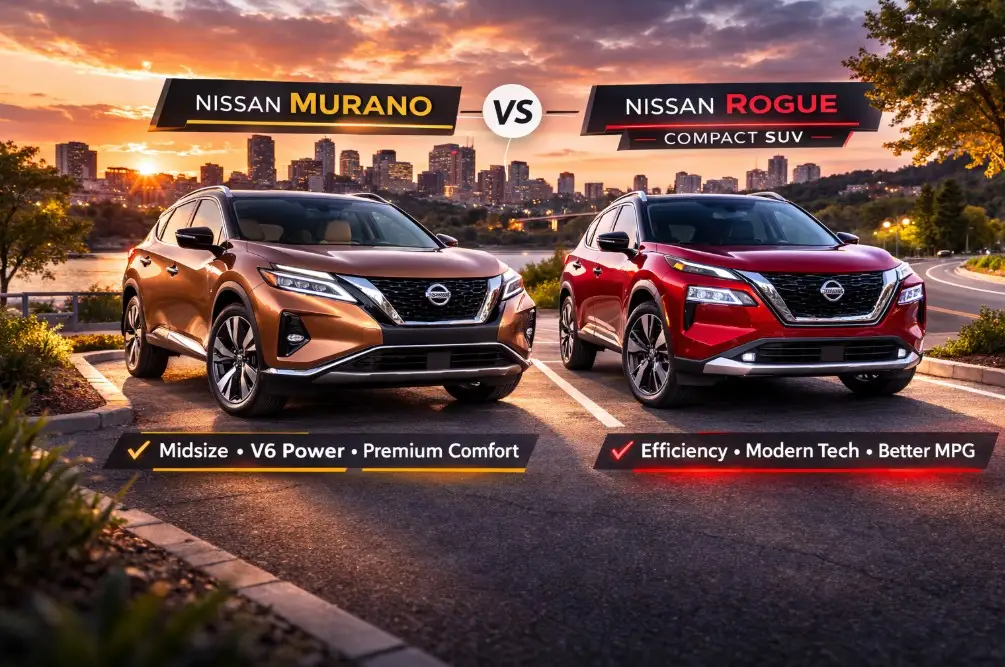
Let’s get straight to it.
Choose the Murano if you:
Choose the Rogue if you:
Murano feels more relaxed and substantial on the highway. The Rogue feels more modern and efficient in everyday commuting. Neither is objectively “better.” They’re built for different drivers.
If comfort and smooth power matter most, Murano wins. If efficiency and practicality matter more, Rogue makes stronger financial sense.
Nissan Murano and Rogue sit in separate segments. This is what changes the experience. The Murano is a midsize, which is pretty large overall. It has a longer body and wider stance.
The Rogue is a compact SUV with smaller footprint, and slightly tighter proportions. But here’s what that means in real life.
The Murano offers:
The Rogue offers:
Cargo space differences are noticeable but not dramatic. The Rogue is surprisingly practical for its size. The Murano gives you slightly more width and depth, but neither offers a third row.
Important clarification:
The Murano is not a three-row hauler. If you need seven seats, look elsewhere. Rear legroom is solid in both, but tall passengers will prefer the Murano for long hauls.
If your routine involves four adults on highway trips, the Murano’s extra cabin width keeps things relaxed.
Do you mostly commute solo or run short family errands? Then, the Rogue is easier to live with. Just know that bigger is not better everytime. It is just different.
Here’s where the personality split really shows.
The Murano uses a 3.5 liter V6 engine producing roughly 260 horsepower. It’s paired with a continuously variable transmission (CVT).
The Rogue uses a 1.5 liter variable compression turbocharged three cylinder engine producing around 201 horsepower; also paired with a CVT.
On paper, that’s a big difference in engine size. On the road, it feels different too.
The Murano’s V6 delivers smoother, more linear acceleration. Highway merging feels effortless. Passing at 70 mph doesn’t require planning ahead. It feels relaxed.
The Rogue’s turbo engine is efficient, but you can tell it’s smaller under heavy acceleration. Around town, it feels responsive. On highways, it works harder.
Is it slow? No. But it doesn’t glide the way the V6 does.
Now let’s talk about the CVT.
Both SUV models come with CVTs, where earlier Nissan CVTs were famous for reliability hassles. Newer versions have improved, but prolonged maintenance still matters.
Driving feel?
The Murano’s larger engine masks the CVT’s behavior better. The Rogue’s smaller engine can sometimes make the transmission feel more noticeable under load.
Do you care about smoothness and effortless power? Murano has the edge. Care about efficiency and don’t drive aggressively? Consider the Rogue!
This is where the numbers matter.
The Rogue can provide about 30 mpg, where Murano averages 23 to 24 mpg combined. That gap adds up.
Drive up to 15 thousand miles each year? Well, the Rogue can save hundreds of bucks annually in fuel costs compared to the Murano.
Over five years? That difference becomes significant. City drivers benefit most from the Rogue’s efficiency. Do you want:
There’s no trick answer. Just trade-offs.
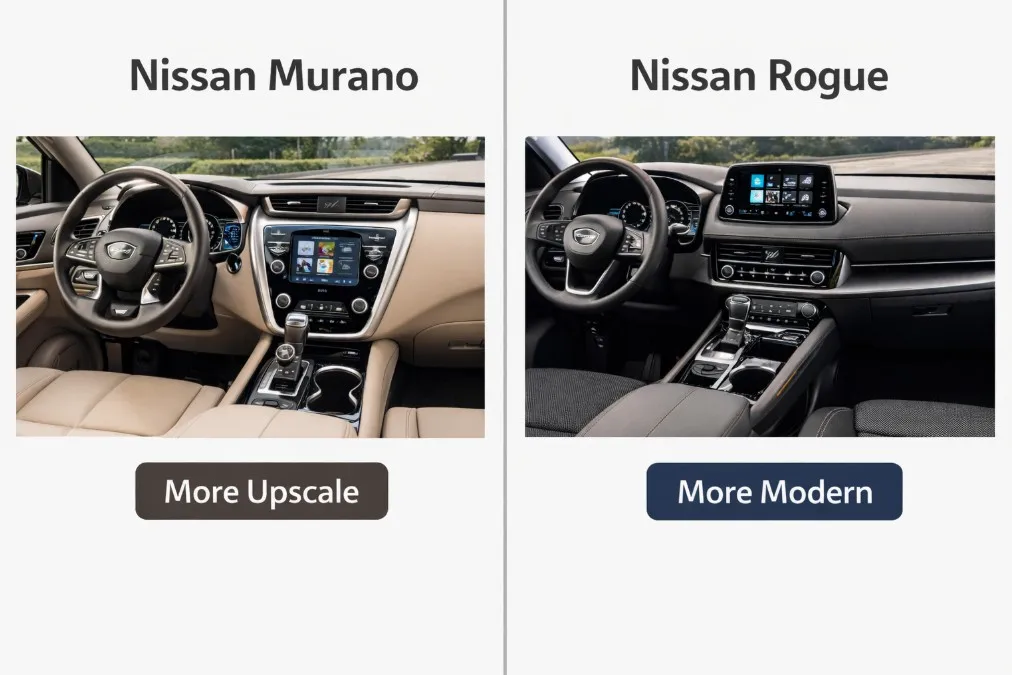
Step inside the Murano and it feels slightly more upscale. Materials are softer.
The seats: often marketed as Nissan’s “Zero Gravity” seats; feel supportive during longer drives. Road noise is well controlled. On highways, the Murano feels quiet and planted.
The Rogue feels newer from a technology standpoint. Newer generations offer larger infotainment screens and more modern dashboard layouts.
The cabin feels practical and thoughtfully organized. Both offer solid rear comfort, but the Murano’s extra width makes long hauls much easier for adults.
The Rogue’s cargo space is surprisingly nimble for a compact. With the fold-down seats , you can easily haul bulky gears in a breeze.
The Murano feels more relaxed during long-distance highway travel. The Rogue feels more manageable in tight urban environments.
Interior quality difference? Murano leans more premium. Rogue leans more modern and efficient.
Spend hours on highways each week? Murano’s quiet ride becomes noticeable. Navigate parking garages and school pickup lanes? Rogue’s size advantage stands out.
Both models come equipped with Nissan’s Safety Shield 360 suite in most recent model years. It typically includes:
So from a baseline safety perspective, you’re covered either way. Where the differences show up is in technology updates.
The newer Rogue models tend to offer:
The Murano’s system works well; but it feels a generation behind in some trims. Its layout is simple and intuitive, just not as flashy or modern as the latest Rogue redesign.
Driver assistance systems like adaptive cruise control work predictably in both. For highway commuters, this feature matters more than screen size.
Care about having the most updated cabin tech and digital layout? The Rogue has a slight edge. Care more about comfort and simplicity? The Murano’s system is perfectly functional.
Let’s talk honestly about reliability; especially transmissions.
Both Murano and Rogue use CVT transmissions. Earlier in the 2010s, they had a reputation for early wear in specific models. That history still follows the brand.
Newer generations have improved. But maintenance is critical.
You’ll see Murano’s 3.5Litre V6 engine is used widely here. It’s generally considered durable when maintained properly. Oil changes and transmission fluid service matter.
The Rogue’s new 1.5L variable compression turbo engine is complex and efficient. It’s efficient. Yet, prolonged durability is still in evolution as more vehicles age past 100,000 miles.
Common themes reported by owners over various model years include:
These aren’t universal issues; but they’re worth researching by model year before purchasing. If you’re in California and believe your Nissan qualifies as a defective vehicle, understanding your rights under the California lemon law could help you pursue a refund or replacement. The Murano benefits from using a well-established V6 platform. It feels proven.
The Rogue benefits from being newer in design but relies more on turbocharging and smaller displacement efficiency.
Neither SUV has a widespread catastrophic failure pattern dominating recent headlines. But both require consistent maintenance; especially CVT fluid service.
Long-term mechanical simplicity matters to you? The Murano’s naturally aspirated V6 may feel more reassuring. Prioritize efficiency and newer tech? The Rogue makes sense; just stay on top of service intervals.
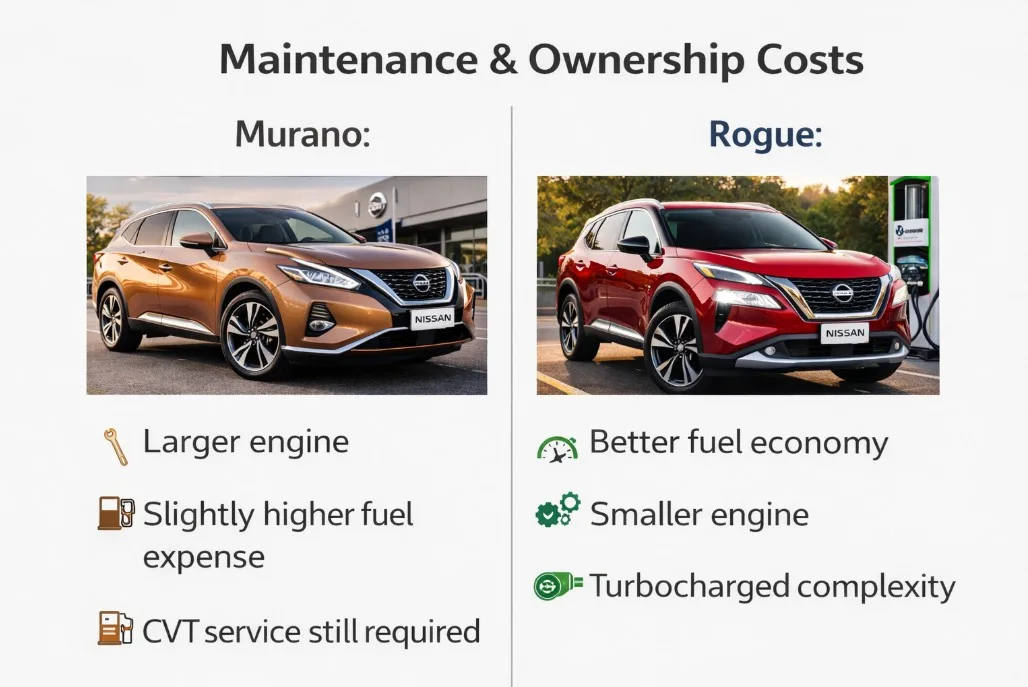
Ownership cost isn’t just fuel. Insurance rates for both SUVs land in the same ballpark, though the Murano costs more to cover.
Its bigger footprint and higher price tag drive those premiums up. Fuel costs, as noted, give the Rogue a massive lead over the long haul.
Maintenance comparisons:
Murano:
Rogue:
Brake and tire wear are comparable. However, due to the Murano’s heavier weight the tire may wear slightly faster over time.
Warranty coverage is similar between the two, depending on model year. Over a five-year period, the Rogue generally costs less to operate due to fuel savings.
Over a ten-year horizon, maintenance discipline matters more than brand perception. If you’re shopping used, service history is more important than which badge is on the hood.
The Murano feels heavier; in a good way. On highways, it feels planted and smooth. Road imperfections are absorbed gently. Cabin noise is minimal. It’s built for relaxed cruising.
The Rogue feels lighter and more agile. In city driving, that agility helps. Tight turns and parking feel easier. The ride is slightly firmer than the Murano, but not harsh.
Long highway commutes? Murano wins for comfort. Daily suburban errands and parking garages? Rogue feels more manageable.
If you regularly drive long distances with passengers, Murano’s suspension tuning becomes noticeable.
If you value nimble handling in traffic, Rogue feels more at home. Again; not better. Just different.
Compact SUVs hold value because everyone wants one. The Rogue sits right in that sweet spot. That keeps its resale price competitive.
The Murano serves a niche since it skips the third row. Fuel trends also steer the market. When gas prices spike, efficient rides win the used car lot.
Historically, the gap between these two is small. The Rogue might lead by a nose because compacts are king. In the end, maintenance and mileage beat any segment label.
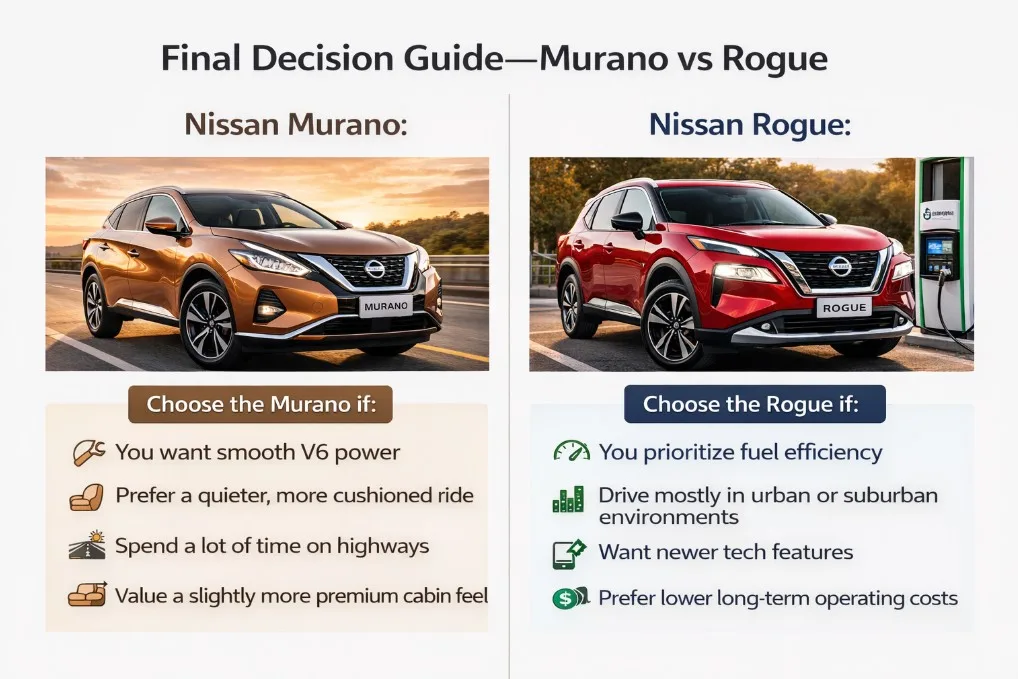
Here’s the decision in simple terms.
Go for the Murano if:
Go for the Rogue if:
Both are practical two-row SUVs. Both can serve families well. The smarter choice depends on how you drive; not which one is larger.
If comfort and smoothness matter more, Murano is the better fit. If efficiency and modern updates matter more, Rogue makes stronger financial sense.
 $26,534
$24,110
$23,345
$23,000
$22,195
$22,000
$21,586
$21,550
$20,183
$20,000
$20,000
$19,411
$18,000
$18,000
$17,000
$16,000
Consumer Protection
$26,534
$24,110
$23,345
$23,000
$22,195
$22,000
$21,586
$21,550
$20,183
$20,000
$20,000
$19,411
$18,000
$18,000
$17,000
$16,000
Consumer Protection
 Call (424) 677-1115